VSME has a new name. Since 24 September 2026 the voluntary sustainability standard for smaller companies is officially the Voluntary Standard, or VS, set out in Commission Delegated Regulation (EU) 2026/1560. Most of what you already know about VSME still holds. The changes that matter are who can use it, what legal weight it now has, and a cap on how much data large customers can ask you for.
This article is for two groups. Suppliers and other companies with up to 1,000 employees who get ESG questionnaires from customers and banks. And CSRD companies that send those questionnaires.
From VSME to VS in two years
The standard went from an EFRAG draft to EU law in under two years. The value chain cap is the last piece and applies from financial year 2027.
17 Dec 2024: EFRAG delivers the VSME standard
30 Jul 2025: the Commission publishes VSME as Recommendation (EU) 2025/1710
Mar 2026: Omnibus I enters into force. CSRD scope is narrowed and the value chain cap is introduced
3 Jul 2026: the Commission adopts the delegated act, together with the revised ESRS
21 Sep 2026: published in the Official Journal as Delegated Regulation (EU) 2026/1560
24 Sep 2026: VS enters into force and the 2025 VSME Recommendation stops having legal effect
1 Jan 2027: the value chain cap applies to financial years starting on or after this date
If you publish a report for 2026, you can already follow the VS.
What stays the same
If you have already reported under VSME, your work carries over. The structure is the one you know:
Basic Module with disclosures B1 to B11, the minimum for everyone using the standard
Comprehensive Module with C1 to C9, on top of the Basic Module
No double materiality assessment
No requirement for external assurance
Using it is still voluntary. VS creates no reporting obligation for anyone
EFRAG keeps publishing guidance and templates on its Knowledge Hub. Updated versions of the digital template and XBRL taxonomy are expected in Q4 2026. We summarised EFRAG's October outreach event in From VSME to the Voluntary Standard: key takeaways.
What has changed
The biggest change is the value chain cap. Name, scope and legal status changed too, and a handful of datapoints were removed, moved or simplified.
Name and legal status
The "SME" is gone because the standard no longer only targets SMEs. VSME was an EFRAG standard and later a Commission recommendation. VS is a delegated regulation, which is EU law. You will still hear people say VSME for years, and both names refer to the same standard.
Who can use it
VSME was written for non-listed micro, small and medium-sized companies. VS covers any company outside mandatory CSRD reporting with on average up to 1,000 employees in the previous financial year. There is no turnover criterion in the VS itself. The €450 million you may have seen is the CSRD threshold, not a VS limit. Listed small companies, sole traders and mid-sized companies with a few hundred employees can all use it.
The value chain cap
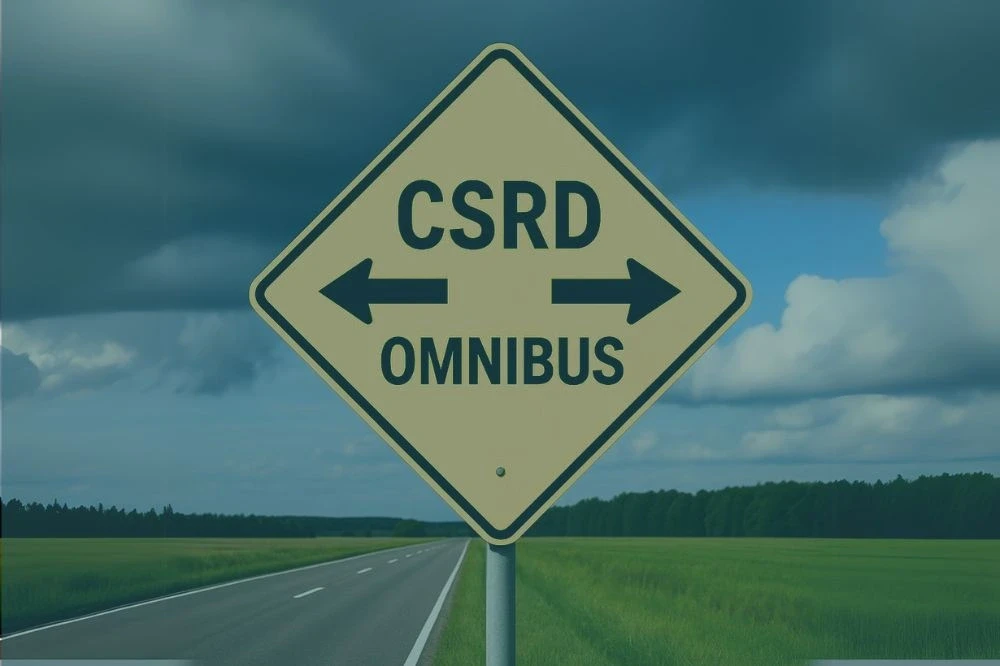
This is the change with the most practical effect. From financial year 2027, a company reporting under CSRD cannot require more information from a value chain partner with up to 1,000 employees than what is listed in Annex II of the VS.
Annex II lists 23 datapoints for companies with more than 10 employees. For companies with 10 or fewer, the list is 9 datapoints, with no environmental data.
The CSRD company can still ask for more. It has to make clear that the extra request goes beyond the cap, and the supplier can decline.
The cap only covers requests made for CSRD reporting. Requests based on other EU or national law, contract terms, procurement or financing fall outside it.
Banks, insurers and investors are encouraged (not required) to keep their requests within the standard too.
Datapoints removed, moved and simplified
B1: explicit statement of compliance with the standard added
B3: GHG intensity per revenue removed
B5: land-use area metrics removed. Sites in or near biodiversity-sensitive areas are listed with the area named
B7: tonnes of waste recycled or reused replaced by the share recycled or prepared for reuse
B8 to C5: employee turnover rate moved from the Basic to the Comprehensive Module
B10: gender pay gap only where law already requires it. Training hours no longer split by gender
C8: exclusion from EU Paris-aligned benchmarks removed
Two new options were added. You can leave out sensitive information such as trade secrets or classified information, and you can publish one combined report with your EMAS environmental statement.
Relief for the smallest companies
Companies with 10 employees or fewer can treat some disclosures as voluntary that are "necessary" for larger companies. In the Basic Module this covers energy and GHG emissions (B3), water (B6) and waste (B7). In the Comprehensive Module it covers parts of C1, C3, C4, C5, C6 and C7.
What to do now
If you are a supplier with up to 1,000 employees, a VS report lets you answer most ESG questionnaires with one set of numbers. Start with the Basic Module and check which Annex II datapoints apply to your size. When a customer asks for more than the cap from 2027, you can say no, or answer the parts that are easy for you.
If you report under CSRD, look at your supplier questionnaires before your 2027 data collection starts. Anything beyond Annex II needs to be marked as optional, and asking only for what you actually use will save both sides time. Many suppliers will already have a VS report, so ask for it first.
In SustainLab Studio you can collect VS data from your own sites or from suppliers and reuse it year after year.
FAQ
Is VSME the same as VS?
Yes. VS (Voluntary Standard) is the official name of the former VSME since Delegated Regulation (EU) 2026/1560 entered into force on 24 September 2026. The content is largely the same, with some datapoints removed or simplified.
Is the VS mandatory?
No. No company is required to report under the VS. It becomes binding only in one way: CSRD companies cannot require more than Annex II from value chain partners with up to 1,000 employees.
Who can use the VS?
Any company not subject to mandatory CSRD reporting with on average up to 1,000 employees, listed or not. There is no turnover limit.
When does the value chain cap apply?
For financial years starting on or after 1 January 2027.
Can I still use my VSME report?
Yes. The structure (B1 to B11 and C1 to C9) is the same, so data collected for VSME can be reused. Check the datapoints listed above that were removed or changed.
Do I need a double materiality assessment or assurance?
No, neither is required under the VS.