
Structure your sustainability disclosure around the standard that is becoming the baseline for small and mid-market companies across Europe, and get the guidance to make it meaningful. The Voluntary Sustainability Reporting Standard for SMEs (VSME) was developed to give smaller and midmarket companies a proportionate, credible way to disclose sustainability performance.









“We had Excel, multiple files, and many people involved. We needed a way to bring everything together and ensure quality in one place.”
Blentagruppen
Fact summary: VSME and the EU voluntary standard (VS)
Latest update: 4 November 2026
VSME: EFRAG's voluntary sustainability reporting standard for small and medium-sized companies.
VS: the EU's voluntary standard that builds on VSME, Delegated Regulation (EU) 2026/1560. Published 21 September 2026, in force since 24 September 2026.
Structure: a Basic module (B1–B11) and a Comprehensive module (C1–C9).
Value-chain cap: from financial years starting on or after 1 January 2027, companies with up to 1,000 employees cannot be required to provide more than VS Annex II sets out.
Mandatory? No. VSME and VS are voluntary. Companies use them to answer data requests from banks, investors and larger customers.
Official sources: Omnibus I Directive (EU) 2026/470 · VS, Delegated Regulation (EU) 2026/1560
How VSME Reporting Works: From Setup to Export-Ready Disclosures
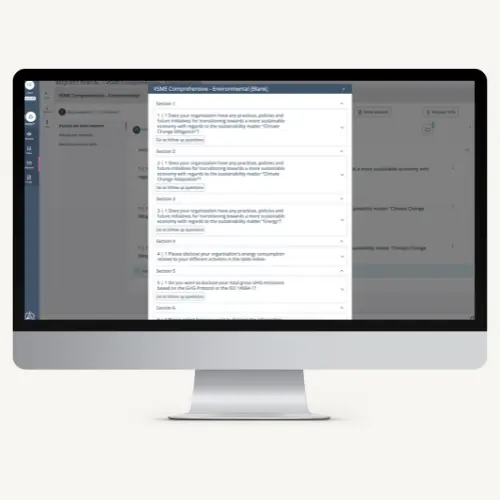
Your customer success manager works with you to identify which VSME topics and disclosures apply to your business, ensuring your setup reflects your actual scope rather than a generic template. The platform is then configured around your applicable disclosures, with reporting templates tailored to your structure. Your team collects information through structured forms, with progress tracked and submissions reviewed before feeding your dashboards and export-ready output. As your reporting needs grow, whether adding GHG calculations, responding to customer requests, or preparing for CSRD, your setup scales with you on the same foundation.
01
You report on the VSME disclosures that apply to your specific business, with a setup configured to your situation.
02
Your sustainability disclosures are structured and ready to be shared with stakeholders.
03
Your team learns more about sustainability and your organisation builds internal capability.
Your VSME data, ready for reporting
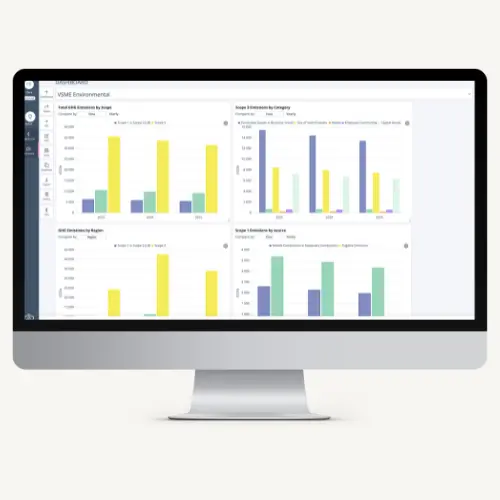
Collect your underlying data to support your VSME reporting.
SustainLab supports with reporting templates for both basic and comprehensive VSME reporting
Support for full traceability from raw input to calculated result, every data point has a documented source and methodology behind it
Combine VSME with our other solutions
Our solutions cover a broad scope of sustainability data and reporting, from GHG calculations and ESRS disclosures to supplier assessments and investor frameworks. Each one combines platform technology with human sustainability expertise, so you get a working setup, not just a tool. Start with what is most relevant today and add more as your obligations and ambitions grow. Read more about each of our solutions below!
Services
Modular sustainability services designed to complement your platform and build your internal capability over time.
Read more →
GHG Calculations and Climate Reporting
Calculate your Scope 1, 2, and 3 emissions accurately with verified emission factors, and methodology documentation.
Read more →
Custom Frameworks
Build a custom reporting setup for investors, customers or specific frameworks . Collect data once, structure once, and use across all your frameworks.
Read more →
Who is this solution for?
This solution is for any SME that reports or is planning to report under the VSME standard, whether the driver is requirements from customers in the value chain, investor expectations, or an ambition to get ahead of future obligations. It is designed for companies already receiving data requests from larger business partners, organisations that want to establish a structured sustainability process ahead of upcoming requirements, and companies preparing to eventually meet CSRD requirements in their own right. It is also relevant for those who want to start with VSME Basic and gradually scale to Comprehensive as reporting ambitions grow. If your sustainability data currently lives across spreadsheets, email threads, and disconnected systems, this solution brings it together in a single, traceable structure.
It is particularly well suited for SMEs with multiple sites or legal entities, distributed data ownership across teams and departments, or where sustainability data is currently managed across several systems without a consistent format or audit trail.
Do you want to know more?
Sustainability reporting is complex, and most organisations are figuring it out while managing everything else at the same time. SustainLab gives you a data-first platform and a team of sustainability experts who work with you from day one — so you get a working setup, not just a tool to figure out on your own. Whether you are just getting started or looking to strengthen what you already have, we will help you find the right solution for where you are right now.
Talk to our team
Get expert guidance tailored to your organisation. Whether you’re starting from scratch or refining your current set-up, we’ll help you navigate requirements, avoid common pitfalls, and move forward with confidence.
Contact us here!
Book a demo
See the platform in action with examples relevant to your industry and reporting situation. A demo gives you a clear picture of what working with SustainLab looks like in practice, with reference to your unique challenges, needs and ambitions.
Book a demo
FAQ VSME
What is the VSME standard?
VSME is EFRAG’s voluntary sustainability reporting standard for SMEs, structured to align with ESRS language and categories. VS, the EU’s voluntary standard that builds on VSME, was published on 21 September 2026. From financial year 2027, companies with at most 1,000 employees cannot be required to provide more datapoints than VS contains. It gives companies a simplified way to respond to sustainability data requests from banks, investors, or larger companies in their value chain.
What does the VSME standard cover?
VSME covers governance, strategy, risk management, metrics, and targets related to environmental, social, and human capital areas. It’s structured by material topics. If your company isn’t in energy-intensive operations, you can focus on topics that actually matter to your business.
Why choose the Comprehensive Module for VSME?
The Comprehensive Module includes all VSME topics and gives you a complete ESG picture. It’s useful if you want to prepare for future growth, operate across multiple countries with different expectations, or want to stay ahead as the standard evolves.
How often is reporting required?
VSME reporting is voluntary, so there’s no statutory filing deadline the way there is for mandatory CSRD reporting. Most companies publish on an annual cycle tied to their financial year, usually because a bank, investor, or key customer has asked for it. We help you set a realistic reporting calendar based on those relationships rather than a legal deadline.
What changes for VSME in 2026?
The European Commission has adopted VS, a voluntary standard that builds on VSME, as Delegated Regulation (EU) 2026/1560. It was published on 21 September 2026 and has applied since 24 September 2026. VS keeps the Basic and Comprehensive modules and simplifies some disclosures. For financial years starting on or after 1 January 2027, companies with up to 1,000 employees can decline value-chain data requests that go beyond what VS lists. If you already report under VSME, most of your data carries over.
Can we transition from VSME to full ESRS easily if our company grows?
Yes, in structure. VSME’s categories and data points are designed to map onto ESRS, so your existing data and processes carry over rather than needing a rebuild. Growing does not automatically bring mandatory reporting: after Omnibus I (Directive (EU) 2026/470), ESRS reporting under CSRD applies to companies with on average more than 1,000 employees and more than EUR 450 million in net turnover, which report for the first time in 2028 for financial years beginning on or after 1 January 2027. Below that, VSME, and VS which builds on it, can remain the right tool for longer than clients might expect.
Does VSME allow us to report on topics beyond what’s required?
Yes, absolutely. VSME defines the minimum, and you can expand scope and report on additional topics if they’re material or strategically important. Many companies use VSME as a foundation but voluntarily disclose on broader topics for stakeholder engagement.