
Collect the data that underpins your ESRS disclosures, structure it correctly across your organisation, and produce output that is ready to feed your sustainability report. SustainLab's focus is the data layer, building the infrastructure that makes your CSRD disclosures credible and traceable. We configure data collection against your selected ESRS standards, ensure every disclosure requirement is backed by reliable, documented data, and produce export-ready output that flows directly into your reporting process.











The CSRD Gap Analysis with SustainLab really helped us create the best conditions to prepare for CSRD. Our internal knowledge was initially limited, and the external expertise we received at this early stage was therefore invaluable.
Clas Ohlson
Fact summary: ESRS and double materiality
Latest update: 4 November 2026
ESRS: the European Sustainability Reporting Standards, used for sustainability reporting under CSRD.
Who must report: companies with more than 1,000 employees and over EUR 450 million in net turnover, after the Omnibus I directive (in force 18 March 2026).
Revised ESRS: Delegated Regulation (EU) 2026/1563, mandatory for financial years starting on or after 1 January 2027. For 2026, companies may choose which version to apply.
Double materiality: assess impact materiality (your effects on people and the environment) and financial materiality (sustainability effects on your business) to decide what to report.
National law: EU member states must bring the Omnibus changes into national law by 19 March 2027.
Official sources: Omnibus I Directive (EU) 2026/470 · Revised ESRS, Delegated Regulation (EU) 2026/1563
How ESRS Reporting Works: From Data Collection to Audit-Ready Output
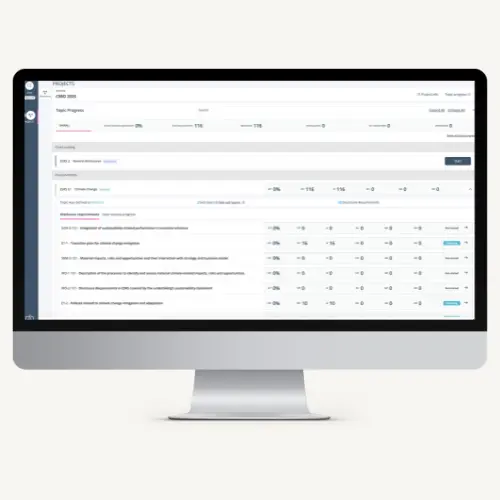
Your dedicated customer success manager sets up your ESRS scope as you advise, maps your organisation, and configures data collection structures before you begin working in the platform. Data owners receive structured requests through the platform, gaps are documented, and submissions are reviewed for quality throughout. SustainLab handles both quantitative and qualitative ESRS disclosures, with exports of data ready for your sustainability report.
01
Every ESRS disclosure you produce is backed by documented, traceable data and audit ready.
02
Your reporting organisation contribute data through a process with clear instructions, reducing the burden on individual people and reducing dependence.
03
Both quantitative data and narrative disclosures are covered, and we can support with data strategy for both.
Your ESRS data, ready for audit
Collect your underlying data to support your ESRS reporting.
SustainLab supports with data strategy, calculations and adding estimations and proxies
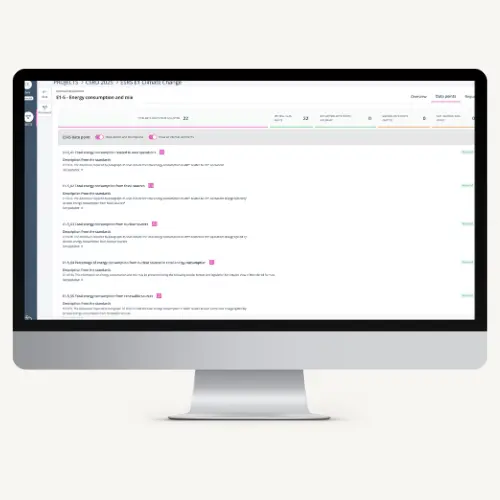
Support for full traceability from raw input to calculated result, every data point has a documented source and methodology behind it
Combine ESRS with our other solutions
Our solutions cover a broad scope of sustainability data and reporting, from GHG calculations and ESRS disclosures to supplier assessments and investor frameworks. Each one combines platform technology with human sustainability expertise, so you get a working setup, not just a tool. Start with what is most relevant today and add more as your obligations and ambitions grow. Read more about each of our solutions below!
Services
Modular sustainability services designed to complement your platform and build your internal capability over time.
Read more →
GHG Calculations and Climate Reporting
Calculate your Scope 1, 2, and 3 emissions accurately with verified emission factors, and methodology documentation.
Read more →
Custom Frameworks
Build a custom reporting setup for investors, customers or specific frameworks . Collect data once, structure once, and use across all your frameworks.
Read more →
Who is this solution for?
This solution is right for any organisation reporting against ESRS standards, whether that obligation is mandatory or voluntary. It serves companies in mandatory CSRD scope, organisations voluntarily adopting ESRS for investor or stakeholder reporting, and companies preparing for their first mandatory reporting in 2028, for financial years beginning on or after 1 January 2027. It is also relevant for those already reporting under the 2023 standards [KOLLA] who want to strengthen data quality, and for organisations beginning to prepare for the revised ESRS, which apply to financial years beginning on or after 1 January 2027. If your sustainability data currently lives across spreadsheets, emails, and disconnected systems, this solution brings it into a single, auditable structure.
It is particularly valuable for companies with complex organisational structures, multiple sites or entities, distributed data ownership across teams and departments, or where sustainability data currently sits in several different systems with no consistent format or audit trail.
Do you want to know more?
Sustainability reporting is complex, and most organisations are figuring it out while managing everything else at the same time. SustainLab gives you a data-first platform and a team of sustainability experts who work with you from day one — so you get a working setup, not just a tool to figure out on your own. Whether you are just getting started or looking to strengthen what you already have, we will help you find the right solution for where you are right now.
Talk to our team
Get expert guidance tailored to your organisation. Whether you’re starting from scratch or refining your current set-up, we’ll help you navigate requirements, avoid common pitfalls, and move forward with confidence.
Contact us here!
Book a demo
See the platform in action with examples relevant to your industry and reporting situation. A demo gives you a clear picture of what working with SustainLab looks like in practice, with reference to your unique challenges, needs and ambitions.
Book a demo
FAQs ESRS and CSRD
Who has to report under ESRS and CSRD?
ESRS are the EU standards that companies use for sustainability reporting under the Corporate Sustainability Reporting Directive (CSRD). After Omnibus I (Directive (EU) 2026/470), CSRD applies to companies with on average more than 1,000 employees and more than EUR 450 million in net turnover. These companies report for the first time in 2028, for financial years beginning on or after 1 January 2027.
Why can’t I just use Excel?
ESRS reporting under CSRD requires auditable, traceable processes. Regulators and auditors need to verify data reliability and methodology consistency. Excel doesn’t provide audit trails showing who changed what and when, governance workflows, version control, or control environments. A proper platform gives you documented processes, role-based controls, and proof that data wasn’t accidentally changed.
How does SustainLab simplify ESRS reporting?
We handle four layers of ESRS and CSRD complexity: regulatory interpretation (we track ESRS requirements and update the platform as standards clarify), data collection infrastructure (one system to gather from multiple sources), double materiality (we guide formal assessments to define which topics matter), and audit readiness (built-in traceability, documented methodology, approval workflows, and audit trails).
Does SustainLab provide real-time analytics and dashboards for tracking sustainability performance?
Yes. Dashboards update as soon as new data is entered or imported, so you can follow emissions, energy, workforce and other KPIs per site, subsidiary or group during the year, not only at reporting time. You decide who sees which dashboard through role-based access.
Does SustainLab help track reporting deadlines and ensure compliance with CSRD timelines?
Yes. We track regulatory timelines, including filing deadlines, new framework requirements, and rule changes, and flag important dates for your team. We can help you plan your reporting calendar, coordinate with internal stakeholders, and prepare for audits.
What is double materiality and why do ESRS require it?
Double materiality means looking at your sustainability topics from two directions: which ones affect your company financially (financial materiality) and which ones your company affects in the world (impact materiality). A topic is reported if it is material from either direction. The revised ESRS keep this assessment, in a simpler and more top-down form than the 2023 version. Our Sustainability Strategy Services include a formal double materiality assessment, and the result decides which datapoints we set up in the platform.
How does the software help with data collection?
Reporting responsibilities can be assigned directly within the module, making data collection more efficient and ensuring accountability across the team.
What is the ultimate benefit for users?
By simplifying the process, users can focus less on navigating standards and more on deriving actionable sustainability insights.
Which specific ESRS datapoints does SustainLab support?
SustainLab supports the mandatory datapoints in the revised ESRS (Delegated Regulation (EU) 2026/1563), published in the EU Official Journal on 21 September 2026 and applying to financial years beginning on or after 1 January 2027. The revised standards have more than 60 % fewer mandatory datapoints than the 2023 ESRS. You select the datapoints that are material for your business, and we add custom disclosures if you need them. The platform is updated as clarifications and sector standards are released.
Let's accelerate change for better business - better planet!