Every business decision worth making runs on data somewhere underneath it. Pricing, hiring, forecasting, none of it works without numbers people trust. Sustainability work is no different, even though it's often treated that way and reporting layers take up more head space. At SustainLab, we were founded on the belief that up to date, quality data, can make changes and drive better business at the same time. With sustainability reporting becoming more regulated, common and important, we see that a strong foundation and data is even more valuable. Let's show you why and how to work with it!
Why now?
The numbers back this up, a 2024 Bloomberg ESG data survey found that 63% of investors name the quality and coverage of reported ESG data as their top concern, ahead of the targets or narrative around it. Across the first wave of CSRD reports, improving data quality is one of the most repeated forward-looking commitments companies make about themselves, which is a polite way of saying most people know their own foundation isn't solid yet, but they want to improve! In 2026, we are closing the window in which you can say “we are improving our data quality”, and soon, it will be expected of companies to have transparency in their reporting that can be followed as well.
What does a data first approach actually mean?
A data first approach means treating your sustainability data as the thing you're building, not a byproduct of the report you happen to owe this year. In practice, that comes down to three things:
Every data point has a clear source and a clear owner, not a "someone probably knows this" answer
Data is structured once and reused across every framework or request that needs it, instead of rebuilt each time
There's a traceable path from the number in a report back to where it actually came from
There's a simple test for whether a figure clears that bar: does it answer how much, what exactly, and how do you know? "Around 500 kg of waste" answers none of those, but a number that states the exact amount, breaks it down by category, and documents how it was collected and verified answers all three, and with that kind of information, you don't just have information, you gain knowledge and wisdom, the basis for better understanding, and decision making. Decisions that can be made in sustainability can be to see trends, understand where capital investments should be made and how carbon reduction initiatives should be planned and more.
Why doesn't reporting first hold up?
Most sustainability tools, and most in-house setups, start from the opposite direction: here's the report we need to produce, now let's collect whatever fills it in. That works right up until the report changes shape, which in sustainability regulation happens more often than anyone would like.
It also tends to quietly push companies down a well-known slope: Data quality runs on a spectrum, from supplier-specific measured figures at the accurate, traceable, assurance-ready end, down through hybrid data, average-data based on industry factors, to spend-based estimates (money spent times a spend factor) at the other end, which is the roughest kind of estimate and the one most likely to hide your real performance. Legacy ESG software and Excel don't force anyone down that slope on purpose. They just make the easy path and the spend-based path the same path, and the gap only becomes visible once someone, an auditor, an investor, a new customer, asks a question the estimate can't answer.
That's the other reason reporting first is expensive in a way that doesn't show up right away. A report isn't one step, it's the end of a chain: collection, calculation, aggregation, disclosure. An error introduced at collection doesn't stay contained there, it travels through every step after it, and it gets more expensive to fix the further downstream it goes. A data point that takes five minutes to correct at collection can take a week to unwind once it's already been calculated, published, and questioned by an auditor. Garbage in, garbage out is an old saying for a reason, and with a systems mindset, the data collection and data input into an esg software is important!
How does a data first approach actually get implemented?
To begin with a data first approach, we recommend doing an audit or gap analysis of your data. This means understanding your data completeness, quality and consistency, methodology and calculations, and the ambition level that you have for it to improve. Is the goal reporting better, adding sustainability insights to business decisions, etc., knowing the bar helps you with making decisions and prioritizing efforts.
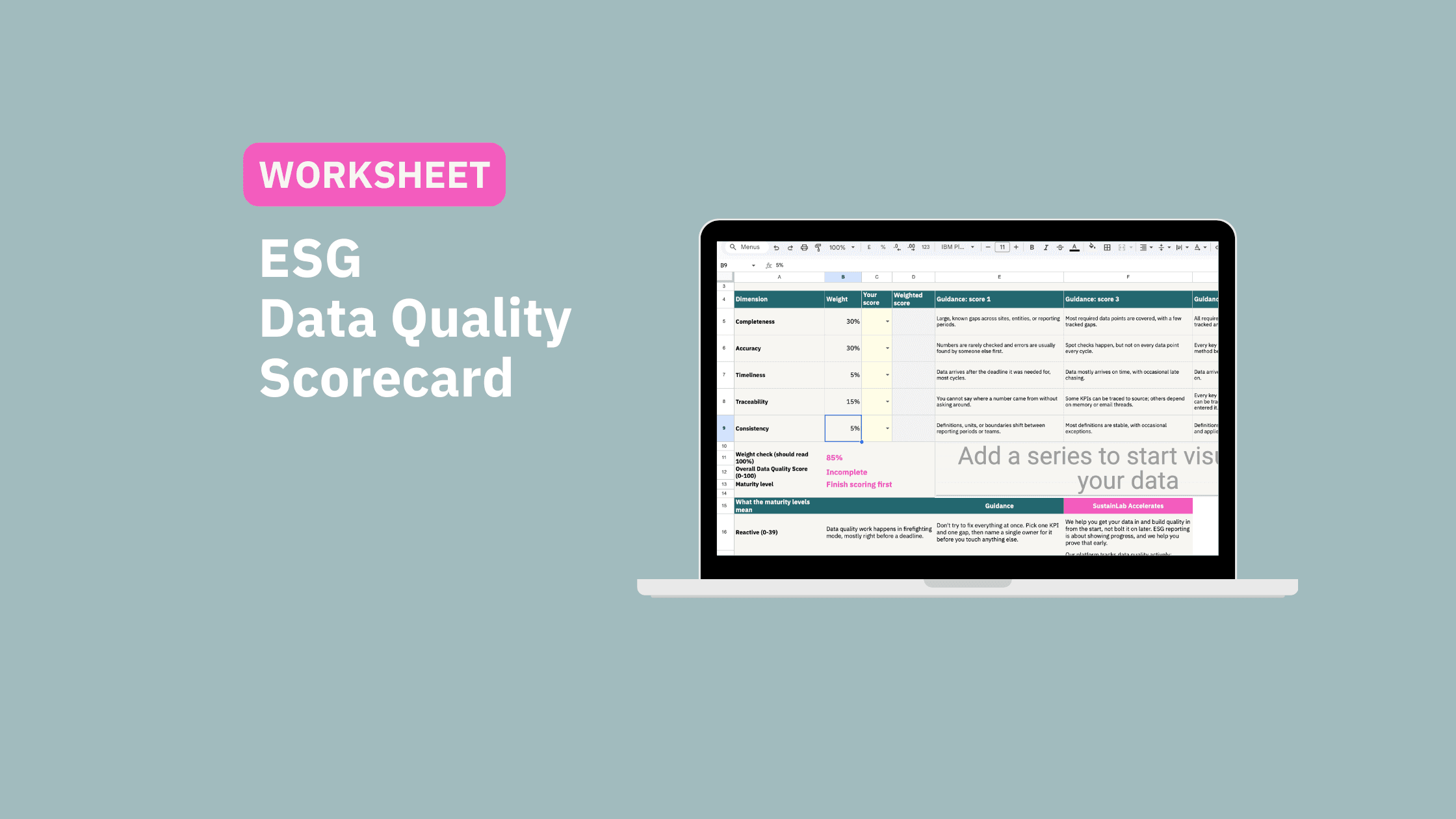
If it's useful to have a starting point rather than building this from scratch, SustainLab's own Data Quality Strategy Scorecard walks through exactly this. It scores five weighted dimensions, completeness, accuracy, timeliness, traceability, and consistency, against a documented maturity scale from Reactive through Developing, Structured, and Advanced, and turns the answers into a prioritized gap and action plan with named owners and timelines. Download the Data Quality Strategy Scorecard and score your own setup before your next reporting cycle, if you want to dive deeper and do a thorough analysis, we do that as a project, let us know your goals and we do it as a service.
Why this matters even more with AI in the mix
There's a newer reason this can't wait, on top of the regulatory one. The UK's Financial Reporting Council published research in 2026 on AI in corporate reporting and found that AI only delivers value where the underlying data is structured and reliable. Fragmented data was named as a key constraint. Running an AI tool on top of bad sustainability data doesn't fix the data or gives you good insights. If AI is anywhere in your sustainability roadmap for the next few years, and for most teams it now is, the data work isn't a separate track from that plan, but it should be the foundation and your first step.
None of this is about picking the right framework either. ESRS/CSRD, VSME, GHG Protocol, or purely internal reporting, the foundation underneath all of them is the same, which is exactly why fixing it once pays off regardless of which requirement changes next.
Your Partner for Data First Success
This is where SustainLab's own shape as a company matters, not just its opinion on data. SustainLab is a full sustainability solution provider: a SaaS platform that automates the collection, processing, and visualization of sustainability data, paired with hands-on consultancy, because software alone doesn't fix a data problem and advice alone doesn't scale one. Data quality isn't a feature bolted onto that platform, it's foundational to how the whole thing works, from templates built for the granularity a team actually needs, to traceability by design, to coaching for the people entering the data, since well-prepared reporters are the cheapest quality control there is.
For teams that want a guided version of this rather than a self-serve worksheet, SustainLab already runs a hands-on pilot: a dry run of your reporting process using your real data, workflow, and team, with gaps flagged, fixes documented, and templates fine-tuned along the way.
Curious where your own data foundation actually stands? Download the ESG Data Quality 101 Guide for the fuller picture, or get in touch to talk through what a good starting point is for your team!
Let's accelerate change for better business, better planet!